Strong verbs add action, vitality, color, and zest to your writing. But what are strong verbs? And how do you use them?
This article covers:
What are strong verbs?
Examples of strong verbs
How to choose strong verbs
How to improve your sentences
A list of 351 strong verbs
More sentence examples

How to use strong verbs
 Do you ever read text and wonder …
Why do the words jump off this page?
Why does this writing feel energetic and strong?
Why is it so fast-paced?
And do you wonder why your draft text seems a tad limp in comparison?
It happens to all of us.
First drafts often require an injection of power and pizzazz. First drafts are full of weak verbs, and weak verbs make your writing limp, flabby, and listless.
In contrast, strong verbs add action, vitality, color, and zest. So, the “secret” to writing with gusto is to choose stronger verbs.
Click here to get the 22-page ebook How to Choose Words With Power and Pizzazz (it’s free!)
What are strong verbs?
Strong verbs engage your senses, and help readers picture a scene (verbs in bold):
Strong verbs allow readers to visualize actions. Instead of only reading words, they’re drawn into your writing, experiencing your story.
But strong verbs don’t need to convey powerful action. Subtle action can evoke powerful feelings, too. For instance:
Strong verbs are precise and concrete. In contrast, weak verbs are abstract and generic—they don’t help you visualize a scene. Examples of weak verbs are “to be,” “to provide,” “to add,” and “to utilize.” You can’t picture these words.
For instance, if someone provides feedback, is he shouting his comments? Or lecturing you with a smug face? Or perhaps scribbling a few suggestions in the margin of your handout?
You can’t picture “provide feedback,” but you can visualize “shouting,” “lecturing,” and “scribbling.”
Examples: How strong verbs breathe life into abstract ideas
Over the weekend, I read Ray Bradbury’s “Zen in the Art of Writing.” I enjoyed his word choice, and I loved how his verbs breathe life into abstract concepts, like storytelling and the Muse.
For instance, he describes how he started writing stories based on lists of nouns:
And the stories began to burst, to explode from those memories, hidden in the nouns, lost in the lists.
And he writes about the Muse:
The Muse, then, is the most terrified of all the virgins. She starts if she hears a sound, pales if you ask her questions, spins and vanishes if you disturb her dress.
And on eating books:
I tore out the pages, ate them with salt, doused them with relish, gnawed on the bindings, turned the chapters with my tongue!
Bradbury’s choice of strong verbs (like “gnaw” and “douse”) adds zest and power. He uses few adjectives and adverbs to keep his writing fast-paced.
Strong verbs in business writing
You might think strong verbs are only for fiction writers.
But that’s untrue.
Here’s Nancy Duarte in her book “Resonate” (about engaging your audience with story-based presentations):
Throughout history, presenter-to-audience exchanges have rallied revolutions, spread innovation, and spawned movements.
And:
When a great story is told, we lean forward, and our hearts race as the story unfolds.
And:
Haven’t you often wished you could make customers, employees, investors, or students snap, crackle, pop, and move to the new place they need to be in order to create a new future?
Here’s an example of Apple’s copy:
So whether you’re listening to music, watching videos, or making speakerphone calls, iPhone 7 lets you crank it up. Way, way up.
And:
Apple Watch Series 2 counts more than just steps. It tracks all the ways you move throughout the day, whether you’re walking between meetings, doing cartwheels with your kids, or hitting the gym.
“To do” in the last sentence is, of course, a weak verb. Apple’s copywriters could have changed “doing cartwheels with your kids” into “cartwheeling with your kids” without disrupting the rhythm and making the sentence stronger.
It is nouns and verbs, not their assistants, that give good writing its toughness and color.
~ Strunk and White (in the Elements of Style)
How to choose strong verbs
No clear distinction exists between strong and weak verbs. It’s a gliding scale, and it’s up to you as a writer to decide how strong you’d like your verbs to be.
For instance, “to walk” is stronger than “to go” because it gives you an indication of how someone moved. But stronger options would be: to saunter, to hike, to shuffle, to trudge, to stride, or to plod. Each of these verbs gives you an indication of how someone walked:
- to saunter: picture a girl walking rather leisurely, perhaps peeking into the shop windows
- to hike: picture a woman in walking boots with a backpack, walking at a good pace
- to shuffle: picture an elderly woman moving ahead gingerly, hardly lifting her feet
- to trudge: picture a girl in wellies making a big effort, perhaps walking through the snow or mud
- to stride: picture a lady walking as if on the catwalk, with long strides
- to plod: picture a tired woman with sagging shoulders, walking rather tiredly
Strong verbs can also be used for abstract language. For instance, you could say you generated ideas during your brainstorm session. But how did your ideas arrive? For instance:
- A few ideas popped into your mind
- Your mind exploded with ideas
- A stream of ideas burst forward
- Ideas first trickled, then gushed forth
- The brainstorm session spawned a stream of ideas
Strong verbs are more precise than weak verbs; they can paint clear pictures—even of abstract activities like thinking and generating ideas.
How to improve your sentences with strong verbs
Imagine this: how would readers experience your voice if you used fewer adjectives and adverbs?
Here’s an example of text, sagging under adjectives and adverbs:
To add energy to the text, the first step is to strip the content back to its bare bones:
The stripped down version lacks nuance and color. So, let’s try stronger verbs and add a little context:
The thesaurus is your friend. Use a thesaurus to find more precise alternatives for weak verbs.
Your word choice shapes your voice
Finding your voice is about experimentation.
Write a first draft quickly using the words coming up into your mind.
Then, review your draft. In which sentences can you replace weak with strong verbs?
Which verbs can be more precise? Which verbs are sensory? Which verbs have a strong emotional connotation?
Play with your words. Have fun. And discover your voice.
FREE 22-page ebook
How to Choose Words With Power and Pizzazz
How to Choose Words With Power and Pizzazz
- Discover 4 wordy rules for captivating your audience
- Learn how to fortify and energize your message
- Get examples that show you how to spice up your writing
A list of 351 strong verbs to inspire your writing
The list below is not exhaustive as many more strong verbs exist.
You can use a thesaurus to find other strong verbs, or keep an eye out for interesting verbs while reading.
To determine whether a verb is strong, ask yourself whether the verb has a sensory connotation. Does it make you hear, feel, smell, taste or see something? Does it paint a clear picture?
Onomatopoeic verbs
Onomatopoeic words express a sound, so they’re a sub segment of sensory verbs.
The word onomatopoeia comes from the Greek for making words—the sound has formed the word that represents it.
Examples:
To crack, to tap, to snap, to sputter, to knock, to boom, to clap, to bang, to drum, to squeal, to bump, to chatter, to twitter, to chirp, to clank, to click, to click-clack, to tip-tap, to jingle, to jangle, to rattle, to tinkle, to hush, to murmur, to plop, to pop, to fizz, to sizzle, to swoosh, to gargle, to sizzle, to hiss, to burp, to hiccup, to whack, to thumb, to crunch, to creak, to squeak, to flutter, to giggle, to tee-hee, to cackle, to honk, to hum, to meow, to woof, to munch, to shush, to screech, to slosh, to squish, to whirr, to gnaw
Sensory verbs
Sensory verbs are strong because they paint clear pictures in readers’ minds and make them feel something.
Examples:
To sparkle, to shine, to brighten, to wipe out, to muddle, to dazzle, to spark, to glow, to shimmer, to glimmer, to beam, to ripple, to tickle, to thrill, to explode, to burst, to guzzle, to gobble up, to breeze through, to drool, to spit, to roar, to thunder, to reverberate, to resonate, to rumble, to flavor, to smooth, to rub, to tremble, to whisper, to vibrate, to pulsate, to throb, to quiver, to buzz, to sip, to slurp, to slobber, to blemish, to applaud, to clash, to bounce, to blend, to shake, to savor, to tantalize, to tittilate, to pinch, to stroke, to brush, to bathe, to hose, to douse, to shower, to drench, to spray, to sprinkle, to trickle, to splash, to seep, to slide, to slump, to tumble, to nose-dive, to fly, to float, to clog, to swoop, to propel, to dig in, to dip, to surge, to wolf down, to shovel, to gulp down, to roll, to soar, to curl up, to unfold, to weave, to swipe, to tear, to polish, to pale, to vanish, to spin, to weave, to intertwine, to buckle down, to button up, to pierce, to stick to
Strong action verbs—intransitive
Action verbs propel a sentence forward, keeping readers engaged.
Instead of using weaker words like walk or move, try to describe the movement more precisely so readers can imagine the movement.
Intransitive verbs can stand on their own, without an object. For instance, I walk is intransitive because there’s no object that is walked by me. I hit you is transitive—you are the object as you are hit by me.
Examples:
To stumble, to wobble, to swing, to lurch, to glide, to zip, to sail, to crash, to dive, to tiptoe, to pussyfoot, to duck, to flip-flop, to dilly-dally, to linger, to stall, to sway, to sink, to spurt, to hurry, to dash, to nip, to race, to whiz, to flit, to chew, to stroll, to sashay, to amble, to plod, to ramble, to loiter, to meander, to roam, to snake, to gallivant, to twist, to dance, to jig, to jive, to waltz, to tango, to swirl, to hop, to trip, to skip, to whirl, to gallop, to stride, to zoom, to trot, to dart, to sprint, to shoot, to leap
Strong action verbs—transitive
Below follow examples of words related to holding, pushing, or hitting something.
You can use these verbs for both concrete and abstract concepts. For instance, you can jump-start an engine or you can jump-start your career. You can squeeze a stress ball, or you can squeeze more to-do’s into your calendar. A cow regurgitates grass, and a blogger may regurgitate worn-out topics.
Examples:
To crank up, to flood, to snowball, to skyrocket, to catapult, to flick, to jump-start, to tackle, to grab, to grasp, to wrestle, to poke, to stir, to prod, to stab, to strike, to smash, to hit, to plunge, to drop, to dump, to drain, to squeeze, to topple, to ditch, to block, to muzzle, to electrify, to galvanize, to fire up, to ignite, to kindle, to whip up, to sharpen, to shock, to jolt, to beat, to regurgitate, to trigger, to pocket, to bat, to smack, to slap, to kick, to kick-start, to hammer, to nail, to club, to flog, to clutch, to hook, to cling, to grip
Negative emotional verbs
A verb like to fail has a strong negative connotation but doesn’t necessarily paint an unambiguous or vivid picture in a reader’s mind. Failure comes in different forms—you can marginally fail an exam or your start-up can fail utterly, and the feelings associated can vary. Do you sob for days? Do you fret you’re a failure? Do you feel crippled or bruised by the failure? Do you feel devastated or shrug your shoulders?
Below follow examples of more sensory verbs with negative connotations:
Examples:
To choke, to strangle, to smother, to gag, to suffocate, to throttle, to cry, to howl, to sob, to blubber, to scream, to groan, to moan, to fret, to fume, to bleed, to nag, to steal, to kidnap, to ransack, to loot, to pilfer, to plunder, to snitch, to puke, to vomit, to yelp, to bark, to growl, to grumble, to mutter, to spout, to suck, to scold, to plummet, to collapse, to skid, to agitate, to slave, to labor, to wreck, to ruin, to cripple, to devastate, to decimate, to trash, to shatter, to torpedo, to sabotage, to capsize, to maul, to crush, to slash, to bruise, to hijack
Positive emotional verbs
The verbs below paint strong positive imagery in your reader’s mind.
Your apple tree can blossom, and your blog can flourish. A magician might be spellbinding, but your blog posts can hypnotize readers, too.
Examples:
To flourish, to thrive, to bloom, to blossom, to mushroom, to smile, to grin, to cheer, to raise, to boost, to lift, to bolster, to invigorate, to energize, to excite, to enliven, to fortify, to hearten, to embolden, to animate, to arouse, to hypnotize, to spellbind, to sweep off one’s feet, to fall in love, to treasure, to unclog, to clarify, to disentangle, to liberate, to relieve, to release, to unshackle, to cuddle, to nestle, to huddle, to snuggle, to embrace, to hug, to kiss, to massage, to cradle, to enfold, to envelop, to sprout
Click here to get the 22-page ebook How to Choose Words With Power and Pizzazz (it’s free!)
More Examples: 9+ Sentences With Strong Verbs
1. Strong verbs in Nora Seton’s kitchen
In her book The Kitchen Congregation, Nora Seton describes how she wanted her mother to spend more time with her when she was growing up:
I needed her there with me while I rolled, crawled, wobbled, ran, trampled, and grumbled on the red linoleum tiles of our kitchen floor.
It’s easy to picture the child rolling, crawling, wobbling etc on the kitchen floor? That’s how strong verbs help to paint strong imagery.
The following sentence is from the same book, describing the soaking of the grains:
All morning long the grains softened, gave in, soaked up, plumped, burst, spit their gluten and flavor into the dish.
Strong verbs don’t always come in long strings like that. Sometimes they pop up just here and there in a sentence. Here’s Seton musing in the kitchen:
I imagine a neutrino shower bombarding me, subatomic gunfire, zinging against the stainless steel in my hands and rocketing through the kitchen without trace.
2. Strong verbs on storytelling
Jane Alison uses 3 strong verbs in the title of her book about storytelling: Meander, Spiral Explode: Design and Pattern in Narrative.
Alison suggests patterns are natural and uses strong verbs to describe such patterns:
We follow natural patterns without a thought: coiling a garden hose, stacking boxes, creating a wavering path when walking along the shore. We invoke these patterns to describe motions in our minds, too: someone spirals into despair or compartmentalizes emotions, thoughts meander, heartbreak can be so great we feel we’ll explode.
3. Strong verbs on writing, a cat, and a praying mantis
In her book The Writing Life, Annie Dillard describes what writing is like:
This writing that you do, that so thrills you, that so rocks and exhilarates you, as if you were dancing next to the band, is barely audible to anyone else.
And in her book Pilgrim at Tinker Creek, Dillard uses strong verbs to describes how her cat wakes her up in the middle of the night:
He’d stick his skull under my nose and purr, stinking of urine and blood. Some nights he kneaded my bare chest with his front paws, powerfully, arching his back, as if sharpening his claws, or pummeling a mother for milk.
And she describes a praying mantis laying eggs:
It puffed like a concertina, it throbbed like a bellows; it roved, pumping, over the glistening, clabbered surface of the egg case testing and patting, thrusting and smoothing.
Can you picture all the movements?
4. Strong verbs in the desert
In his book The Secret Knowledge of Water, Craig Childs describes a thunderstorm in the desert:
It sounded like a block of marble cleaved open with a sledgehammer. The sky broke in two with thunder. Echoes pounded back, thrumming against my spine. Lightning shot to the southeast. The air exploded again. Lightning then fell all around, snagging on the higher terrain. Scraps of lightning showed from behind rock towers. I counted the canyons by how many echoes of thunder were returned. Four pulses of thunder: four canyons. Then I heard the tapping. Rain began to fall. Another bolt of lightning. The rain increased, dabbing my face, making the sound of bean-filled rattles. I could hear it up on the cliffs, rain sheeting against rock.
In the above paragraph, the strong verbs describe a multi-sensory experience. There’s movement (cleave open, break in two, explode), sound (pound, thrum, shoot, tap), sight (sheet), and touch (dab).
5. Strong verbs describing an escape on horseback
In his book All the Pretty Horses, Cormac McCarthy describes Rawlins, Blevins, and John Grady escaping on horseback:
The horse skittered past Rawlins sideways, Blevins clinging to the animal’s mane and snatching at his hat. The dogs swarmed wildly over the road and Rawlins’ horse stood and twisted and shook its head and the big bay turned a complete circle and there were three pistol shots from somewhere in the dark all evenly spaced that went pop pop pop. John Grady put the heels of his boots to his horse and leaned low in the saddle and he and Rawlins went pounding up the road. Blevins passed them both, his pale knees clutching the horse and his shirttail flying.
Thanks to the strong verbs, you can see the boys escaping, almost feel the motion, and hear the noise of the hooves pounding up the road. The strong verbs include: skitter, cling, swarm, twist, shake, pound, clutch, and fly.
Note: This post was originally published on 14 February 2016; an expanded version was published on 12 June 2019; last update on 17 June 2022.
Recommended reading on strong writing:
172+ power words to boost your persuasiveness (as proven by science)
5 ways to make your writing more powerful
4 tips on using verbs correctly




Hello Henneke,
Is it ok to share your posts with my friends with the link of this page? Your examples of strong of verbs are great!
Yes, sure. Feel free to share. I’d appreciate it!
How many people know what a block of marble, being cleaved sounds like? overkill?
What’s overkill and what isn’t is personal.
You may find it overkill. But to me, it seems an apt description of a dramatic thunderstorm. From what I’ve read, these storms are violent, and even though I might not know what cleaving a block of marble sounds like, I do know what cleaving a rock sounds like so it’s easy to imagine.
Again, that’s my personal view. It’s not objective, and you may have a different view. It’s like that with many things in writing.
Hi Henneke,
Love, love, love this post. I have been using these lists in my blog posts and I already feel that my writing has more flavor. For quick reference, I keep this open in a tab. I found this is much better than using a thesaurus since a thesaurus lacks such sensory language sometimes.
I really appreciate your work and I always feel more creative when I am reading your posts. Thank You!
That’s such lovely feedback. Thank you so much, Jessica. Happy writing!
Nice write up. Still trying to really work with that creative mindset… Even after knowing all these, when I bring a paper in front of me I still kinda feel blank. Pls I need your advise
You can’t do it all in one go. Start with writing a rough draft and edit later. When you start editing, see it as playing with words. Just try out some different words. Don’t put any pressure on yourself—it’s not about getting it right; it’s about seeing what you like. If you’re stuck, try a thesaurus, or even better: create your own list of favorite words.
Should I leave a comment? I’m kidding, your expression of word verbiage is fantastic. I learned so much just by reading all the examples. “YOU ROCK” I’m writing a book, so Strong Verbs is the vehicle I’m looking for. Keep up the excellent work.
I’m glad you enjoyed my blog post about strong verbs, Vincent. Happy writing!
I constantly teach the importance of strong verbs; this offers a great link. Thank you. Some of your ing examples, while, specific and great words, are not verbs but rather verbals.
It doesn’t matter whether a word is a verb or a verbal adjective, the principle of choosing stronger words applies in the same way.
Henneke, I won’t lie. Indeed you do practice what you are preaching. Your content is powerful and evokes emotions. Also, I can’t help but say that I’ve employed your writing techniques and they are pointing me towards the right path. Thank you for all your insanely useful lessons.👊
Thank you so much, Denniz. I’m glad you’re enjoying my writing and implementing my tips. Happy writing!
I loved reading not only the complete post, but I opened other linked pages side by side..all are depth interactive, and helpful. Thank you so much
I’m glad you’re enjoying my blog, Kavita. Happy writing!
This is GOLDEN! Thank you so much. This is so useful because when writing I stare at the screen ‘thinking’ of the perfect word. I appreciate your post 🙂
I’m glad you enjoyed this, Piper. Happy writing!
It was cool just use different words to make it sound different
I’m glad you enjoyed it, Lyneice!
Morph, co-opt, and jettison are three of my favs.
Non-sequitur:
Allot each human twenty-five !’s a year. Glaring at you too many posters on social media. To me, the writer and the copy appear desperate. Ick.
Yes, so true. I’m not a fan of exclamation marks either. Better to choose your words more carefully.
Dear Henneke,
Most of the examples in this post are in present simple and past simple tense.
Should we only use these two tenses. What about other tenses? How much should we focus on tenses per se while writing articles and/or any other kind of writing?
Maybe this is what a grammar teacher would recommend but I try to write as much as possible in the present tense. I only use the past tense when I have to.
Thank you very much Henneke for a comprehensive article on strong verbs. It is wonderful. Much appreciated. Regards Cally
I’m glad you enjoyed it, Cally. Happy writing!
I am not a writer.
I would compliment you on your blogs. They are very interesting to learn from and really do assist me to learn the difference between different nouns, verbs, pronouns etc.
As I am learning English so I may teach English to others.
Your articles are brilliant and very helpful.
Thank you kindly from South Africa.
I’m glad you’re finding my articles helpful, Shaun. Happy teaching!
Extraordinarily brilliant resource!!
Thank you, Tasneem!
This was the motivation I needed. Thank you!
Great! Happy writing, Lisbeth!
Why you are so awesome? The way you write, OMG!
Thank you, Aamir 🙂
i love reading your great articles and working hard to improve my writing skills.
i love and appreciate your lessons
Thank you, Olufemi. Happy writing!
Amaaaazingggg article!!!! Extraordinary! Thank you so much!! Helping 6th grader with English.
Happy to help 🙂 Good luck with school.
I can’t wait to power up my verbiage. Thanks a lot.
Go for it. Happy power writing, LC. Thank you for stopping by.
As always a great post Henneke!
Thanks for the helpful suggestions to add sparkle to my writing.
Thank you, Marie. Good to see you again! 🙂
This was helpful. Thank you.
What is not clear to me is the way experienced writers appear to see a sentence broken down into grammar.
adjective, subject, verb, adverb, and object (if present). I find it difficult to analyse a sentence in this way before I put the idea into text since it was 50 years ago when I had my last English class.
While I understand the fundamentals of your writing tips, I can’t imagine writing a manuscript with creative passion using only strong nouns and verbs and then adding adjectives and adverbs later. Surely, this must be an acquired skill?
You write your draft sentences first without worrying about grammar and what types of words you’re using. Only when editing, you’ll look at crossing out adverbs and adjectives, and replacing weak words with stronger words. You may find these blog posts with specific editing techniques helpful:
https://www.enchantingmarketing.com/write-clear-and-concise-sentences/
https://www.enchantingmarketing.com/weak-words/
Your articles are mind blowing. Thanks
Thank you, Nisma 🙂
It might have been a good idea to first check if the terms ‘strong verb’ and ‘weak verb’ were already in use and well defined. They are, and they do not mean anything like this. Strong verbs modify an internal vowel sound to form the preterite, while weak verbs use the suffix ‘-ed’ or ‘-d’ to form the preterite.
Hi Nicholas – I’m aware of the grammatical interpretation of strong vs weak verbs.
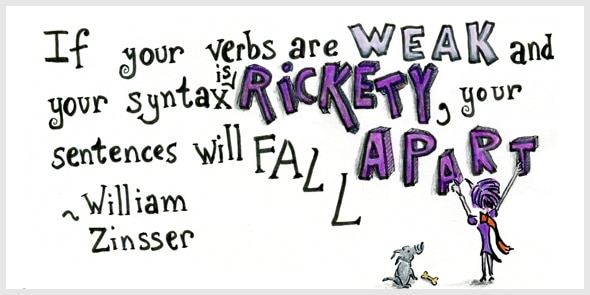
In this article, I have followed the meaning of strong verbs like William Zinsser uses in his book “On Writing Well.” For example, this is a quote from his book: “Again and again in careless writing, strong verbs are weakened by redundant adverbs.” (page 68 in the 30th anniversary edition) It’s similar to the quote on weak verbs I use in the picture at the top of this page.
Good work. I see you as a motivational football coach. You inspired me. Many thanks.
I love inspiring people. But I’m no good at football! 😀
Thanks Henneke for your insight in making sentences come alive. I like your procedure for stripping out flab from the draft text and then enlivening it with action.
All the best from sunny Sydney.
Thank you, Paul. It’s a good way to add both power and pizzazz! 🙂
Oooh, I feel all zingy and raring to go. I’d noticed my copy was becoming boringly, samey and coma inducing to the point I was on autopilot with what I was writing.
I’m going to print off your list of fab verbs and play with my writing.
Thank you!
Be sure to add a few of your own favorites to the list, too. It’s a fun exercise.
Happy writing, Tracey!
This is the third of your many articles I have read in the last hour. Thank you for all this free information. I’m want to be a better writer.
Thank you so very much.
Maurice
Playing with your words is key, I think. Everytime I read something, especially of yours, certain words DO leap off the screen to me.
And I find myself severely disappointed when I read something and it’s just dull and boring. I literally roll my eyes and rush through it hoping there’s at least some valuable gems I could pull from the copy.
Long story short, you hit the nail on the head. I absolutely love “to galvanize” and “to scour”.
– Andrew
You’re very persistent if you persevere in reading boring content!
I’m very impatient as a reader. I rarely read on if I don’t like an opening paragraph.
Isn’t it interesting how we all have our favorite words?
Your post rattled my brain. My brain then shouted, “Are you paying attention? She’s doling out invaluable tools for success!”
How was that? I love your words.
Sam
Great! I like “rattling” and “doling out.”
Thank you for your lovely comment, Sam.
A crackling post which made me jump around in glee like a boy who found his favorite candy.
Rocketed out of my chair and made a dash for my word-weary thesaurus.
Smacking it with new found vigor, I bellowed “Verbs! Let’s get the ship off this bleak shore ensnaring us with its crusty adverbs. Sail yonder into the beckoning seas brimming with enchanting goodies!”
Thanks Henneke for this Whip-up-some-life-in-your-writing post
I love whipping up some life 🙂
Thank you for your comment, Santosh. Happy power writing!
Wonderful! I’m working on a rough draft now of a blog post and know your suggestions will kick it up a notch. I love how you explained “strong verbs” and how to use them to add life to our writing. Thank you for all you do!
Great! I’m glad you find this helpful.
(Sorry for my late reply to your comment – I somehow missed it last month!)
Happy writing, Jenn!
Hi Henneke,
Thanks for inspiring us with these fine examples of strong verbs. As you said, it’s easy to think these are more suited to fiction writing. But the example from Apple shows how you can add some oomph to business writing too.
– David
Indeed, and most business writing can use an injection of oomph 😉
Thank you for stopping by, David. Happy power writing!
Thank you so much for this post. It’s probably my best yet! Loved the breakdown example, the reminder that thesaurus is our friend , and of course the list! I hate to write but this post gives me hope. so encouraging 🙂
What a lovely comment, Lisa. I’m so glad this post gives you hope. I try turning writing into a game and have some fun with my words.
Is there anything specific that you hate about writing?
This post woke me up today. LOVE it. I actually strip strong, simple words from my readings, capturing them on word and idea lists to spice up my writings. Everybody who is intent on persuading needs to gobble up strong words.
To gobble up is one of my faves. I love the sound of gobbling up 🙂
Thank you for your lovely comment, Kathleen. I appreciate it!
Great stuff. I’ve already used it in a couple of business marketing collaterals.
Thanks Henneke
Great!
This is huge! Thank you so much for sharing this, Henneke! I’ve read every single word this information goldmine and it was tremendously helpful.
If you don’t mind, please tell me whether in the sentence, “most of us would rather clean the bathroom than do push-ups,” we should replace the verb “to do.” If the answer is yes, then what’s the alternative?
I appreciate your efforts!
I’d keep “do push-ups.” That’s how people say it. You don’t always need stronger verbs. If every verb in every sentence is strong, then it’s overkill and that’s tiring for your reader. It’s about balance and stressing what’s important.
Amazing help as usual ….thank you Henneke 🙂 great post.
Thank you, Maria. Happy writing!
‘He uses few adjectives and adverbs to keep his writing fast-paced.’ That’s the main thing. Plus concreteness. And then to keep it in mind even if you are tired 😉
At the end of a writing day I am usually too tired to think of good headlines. Not smart, I know. You do such a great job there.
My “secret” trick to writing headlines is to write down a few options (usually one or two days before I publish my post), then read my headlines before I go to sleep and pick a favorite in the morning. Somehow, during my sleep, I often come up with a better one. Don’t tell anyone! 😉
Very wise. And very patient.
Henneke thank you for another thought-provoking piece! Your posts challenge me to dig deep. After devouring this, I want to race to my keyboard and tap away until my words sparkle and shine.
I love the choice of verbs in your comment. I can hear you tapping away on your keyboard. Have fun! 🙂
Awesome! I am bookmarking this post. I will read it again and again and again, to keep reminding myself how to give my writing energy with strong verbs.
Thanks!
Great! Your comment makes me happy. Enjoy your writing, Daniel! 🙂
Another eye opener for me, Henneke. Thank you for your skill in teaching the power of grammar in a shockingly simple way!
I love writing posts like this 🙂 Thank you for your lovely compliment, Fiona. I appreciate it!
This is an excellent post! My writing has been particularly drab. Now, I know why. I am certain that choosing the right verbs as you’ve suggested would add the zest that is sorely needed.
Your site is such an invaluable tool and I so appreciate what you do!
What a lovely comment. Thank you, Patricia. You put a smile on my face.
I’m sure your content isn’t as drab as you think. Happy writing!
Hey this is great stuff, Henneke! The only comment I would make is that I think Apple has it right when they say “doing cartwheels.” For the general public, the expression is to “do a cartwheel” and not “to cartwheel.” Although this verb exists, it’s a different level of language. But I think that it still proves your point, because even if “doing” seems weak ,”doing cartwheels” is very concrete and evocative for the audience, so that’s the most important thing. Just to say, sometimes style is subjective, even when it comes to verbs! Great post!
Yep, that’s totally true: style is subjective, and there are differences between what’s acceptable in American and British English, too. I’m not sure that’s the case here … I might prefer “cartwheeling” because I’m a non-native speaker, but I might be the only one who prefers it 🙂
Thank you for adding your thoughts. I appreciate your comment!
Awesome as always Henneke. I’ll be saving this article to refer back to. What a great way to introduce the concept of strong verbs without it sounding like a boring lecture. I must have read about this concept 100 times before, but never in a way that was this fun to read!
What a lovely compliment, Amy. Thank you. Happy writing!
I just love reading your posts, Henneke, and this one was especially inspiring. I will definitely be referring to it as I attempt to jazz up an otherwise potentially hum-drum website about insurance. (Yawn!) Thank you for all you do–you rock! 🙂
What a lovely comment. Thank you, Kate! And I love the verb “to jazz up.” Great choice! 🙂
Great post. Thanks Henneke. This is one of the points I’m slaving over, along with telling better stories.
I’ve declared war on adverbs. I use the Hemingway app. It helps obliterate adverbs. But now my sights are set on strong verbs. A little more tricky than adverbs, but practice makes perfect.
Timely, again.
It may feel more tricky, but I’d say it’s also more fun. Try turning it in a game … for instance, how many different verbs can you try in the key sentence of your article?
Happy writing, Jansie. And thank you for stopping by to leave a comment.
That’s exactly how I try to approach it. But it’s tiring. If you write long articles like I do, keeping it all together becomes a difficult task. I draw blanks.
Do you take a break between writing a first draft and editing it? This helps me a lot. Plus, when I draw a blank, I use the thesaurus 😉
Definitely take breaks. More than one. Write, edit, write, edit, edit, edit.
Edit more.
Month later, check back again.
Read on laptop; read on mobile.
I’ve long dropped the notion of writing being “art”; that futile fable that, once your article is posted, you’re not allowed to edit it.
Suppose only sticking to it relentlessly will make it come easier. So that’s where I’m at. Your post happened at the right time.
Wowza. This one boggled, blew away and some other cool verb that starts with B. I’m writing a piece about power writing and power verbs is a section. I’ll have to refer to this great post.
I’ll keep an eye out for your post. I’m looking forward to reading it. 🙂
I hope the third verb starting with B wasn’t to bullshit 😉
Hi Henneke,
Thanks for this list of strong verbs. I will surely use them in the next copy I use.
Can we use them on our sales page copy or will it be too loud to use them?
Thanks,
-Swadhin
Yes, sure, you can also use them in sales copy, just use them in a small dosage. Don’t overdo it.
Happy writing, Swadhin!
How totally fun! And wonderful example of transforming a sentence. Something clicked when you said your word choice shapes your voice. Great post!
I also had a lot of fun while writing this – especially with selecting all the examples. 🙂
Happy writing, Kathy!
Thank you so much. This is just what I need, and it has come at the right time too for me.
I’m happy to read that. 🙂 Thank you for stopping by, Helen. Happy writing!
I Appreciate all the work I know this post took. Excellent job and fun to read. Love Zinsser!
Sometimes I like to insert a rest between a long dose of rich words, like a drink of cool water between courses in a meal. In some cases, an uncomplicated break can dramatize sets of contrast, inserting even contrasting types of words. For instance:
He clomped toward me, grabbed my sweatshirt in his filthy fist, and dragged me to the folding chair, which clattered as I bumped it. He roared at me, “SIT!”
I sat.
When I met his steely gaze and did not cry, he slapped me hard, filling the air with his body odor.
An editor once shared with me that she knew I had contributed an anonymous piece for her friend’s magazine, because my style was noticeable, to her.
The contrast I sampled, above, was typical…
Yes, that’s such a good point, and a wonderful example!
I love how you contrast strong action words with the simple “I sat.” The contrast is further stressed because you have a long sentence, then a super-short one. I love it!
I’m not surprised that your writing stands out and your voice is recognized.
Thank you for sharing this, Katharine.
Epic post. Filled with actionable points
Thank you, Peter. Happy power writing!
Wow, what a great resource. For a non native English speaker like me, this is very useful. I will try to use more of this verbs in my writing but also while speaking. Good vocabulary (and verbs) determine the way people see us, better be good and strong!
P.S: I featured one of your SlideShares on today’s article on my blog 😉
Oh, wow, I’m honored to be included in your article. I’m going to check out the other presentations. You made me curious!
Thank you for your lovely comment, Virginia! 🙂
Oh man, this is such a pain point for me as a non-native speaker! 😀 The only way to think beyond “said”, “did”, “was” is to read, and read a lot.
Great reminder, Henneke! Already saved the verbs to my swipe file 🙂
As a non-native speaker, I know the pain of searching for the right word. But, as you suggest, it’s also an opportunity to read more, learn more and play more. I see it as a challenge and a game. Perhaps as non-native speakers we can feel more free to play with different words 🙂
Happy writing, Gill. Thank you for stopping by!
You are such a wonderful writer!
Thank you, John, for your lovely compliment 🙂
Wow, great post! And now my task begins, to translate your list of strong verbs into Dutch 🙂 Somehow I have always thought of English as the more powerful language. But I will hunt those strong Dutch verbs down, so I can make my copy sparkle like yours.
I’d use the list as a starting point, so perhaps translate one of the verbs, and then see which other verbs this reminds you of (a bit like mind-mapping). That’s also how I created this list (and many more strong verbs exist that aren’t on this list). This might be a little faster than translating them all. 🙂
And when you read another interesting verb (in newspapers, blog posts, or fiction), you can add to your list.
Happy writing, Cindy. And thank you for stopping by.