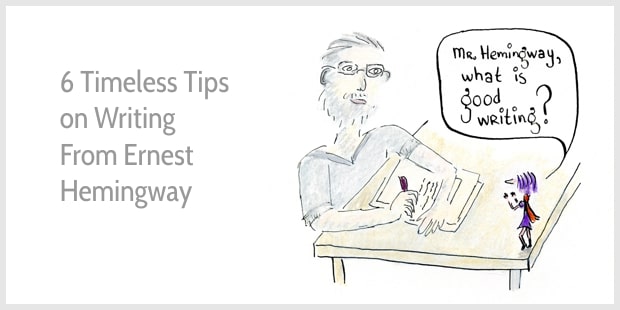
 Henrietta wonders …
Is there’s a secret trick to writing better?
She’s revising her blog post, and she’s pulling out her hair.
She seems to have written a bunch of crappy paragraphs with only a couple of good sentences in between.
Henrietta wonders whether great writers produce such crappy drafts, too. And what if she could ask Ernest Hemingway for advice?
Hemingway’s The Old Man and the Sea is one of Henrietta’s favorite books. Wouldn’t it be great if she could call Hemingway in writers’ heaven for a quick interview on writing?
Unfortunately, I can’t arrange that telephone call.
But I’ve designed another experiment. Henrietta asked me her 6 most pressing questions on writing, and I’ve dug through the book Hemingway on Writing to find the answers of the master himself.
Want to know what Hemingway can tell us about good writing, too?
1. Mr. Hemingway, do you ever write something less than perfect?
Hemingway laughs:
I write one page of masterpiece to ninety one pages of shit. I try to put the shit in the wastebasket.
From a letter to F. Scott Fitzgerald, 1934
It’s easy to think that the writing greats have a natural talent.
Don’t they write with ease?
When we read a good article or a great book, we have no idea how hard a writer has worked. We don’t see their revisions. We can’t see them hitting writer’s block. We can’t sense their despair, and we can’t know how much writing they chucked into the bin.
Hemingway’s quote is a good reminder that writing is hard work, and if you’re finding it a struggle, it’s probably a sign you’re doing it right.
As Hemingway writes in another letter: “Sometimes [writing] is like drilling rock and then blasting it out with charges.”
2. Mr. Hemingway, how many words do you write each day?
Hemingway answers:
[If] I only had 320 [words] I felt good.
From a letter to Maxwell Perkins, 1944
In a letter to his editor Maxwell Perkins, Hemingway complains Charlie Scribner (his publisher) is ridiculing his daily word count. He suggests Scribner doesn’t understand him nor writing.
Hemingway’s usual pace is 400 to 600 words per day, but if it’s slightly less, that’s fine with him, too.
Sometimes writing can feel like a competition. Who can write the most words in one day?
But writing as many words as you can doesn’t necessarily increase your productivity.
For instance, when author Mark Manson joined a writing group, they all tried to outdo each other and write more. It’s like binge writing. But as Manson found, most of his quickly written work was poor. When he slowed down and limited his writing to two hours a day, he produced his book way faster because he didn’t need to spend so much time revising.
Setting a daily word count as a goal can help overcome procrastination so you can write faster. But be careful. Too high a word count can work counterproductive, and many people find it easier to set a time target—writing for 20 minutes or 2 hours per day.
Do what works for you, and don’t let others ridicule your writing pace.
3. Mr. Hemingway, I find it hard to start writing in the morning. How can I make it easier?
Hemingway suggests:
The best way is always to stop when you are going good and when you know what will happen next.
From: By-Line: Ernest Hemingway, pp. 216–217
This is a fabulous trick to prevent procrastination. When you stop writing before you’re empty, starting the next day is so much easier because you already know what you want to write next.
And what’s more …
While you weren’t writing, your subconscious continued working on your ideas, so new ideas pop up, making writing even easier the next day.
Twyla Tharp calls it building a bridge to tomorrow, and it has reduced my writing stress and multiplied my productivity.
4. Mr. Hemingway, do you ever hit writer’s block?
Yes, even Hemingway gets stuck sometimes:
I would stand and look out over the roofs of Paris and think, “Do not worry. You have always written before and you will write now. All you have to do is write one true sentence. Write the truest sentence that you know.”
From: A Moveable Feast, p. 12
Isn’t it reassuring even a writer like Hemingway suffers from writer’s block?
Writer’s block isn’t an unmovable block. It’s more a hesitation to write, usually fueled by fear. A fear that we’re not good enough, a fear that we’ve lost our mojo, or that we can never write anything as good as that one masterpiece again.
And the solution to that hesitation to write?
Exactly as Hemingway suggests—to make our next writing task as small as possible. Hemingway suggests writing one true sentence. But when I struggle to get into writing mode, I don’t even care whether that first sentence is true. I simply have to get my fingers moving on the keyboard. Write any sentence and the words will flow again.
5. Mr Hemingway, what is good writing?
Hemingway answers:
Good writing is true writing.
From: By-Line: Ernest Hemingway, p. 215
I was a little surprised by this statement.
Isn’t Hemingway’s The Old Man and the Sea a made up story?
Yes, but it’s based on Hemingway’s own fishing experiences combined with fishing stories from his Cuban friend Carlos, as his publisher writes in a foreword to the book. The details feel real, and these details help us, as readers, imagine and experience the story as if we’re on the fishing trip with the old man.
And it’s a lack of detail that often makes writing bland. If you leave out all details from a story or tutorial, readers sense you don’t know what you’re writing about.
That doesn’t mean you need to be an expert to write a blog post. You can share what you’re learning while you’re learning—that’s how I’m blogging, too.
As Hemingway writes in another letter, “whatever success I have had has been through writing what I know about.”
6. And what is the biggest mistake bad writers make?
Hemingway answers:
[All] bad writers are in love with the epic.
From: Death in the Afternoon, p. 54
We only have to read The Old Man and the Sea to know how much Hemingway appreciated simple language. He acknowledges it’s taken his whole life to write in such simple, concise prose.
But it’s a lesson we do well to remember.
Because we don’t write to impress.
We write to entertain, to educate, to share our stories, to connect, and to comfort our readers.
Book mentioned in this post
Combine with Bird by Bird by Ann Lamott and Stephen King’s On Writing for more insight on the writing process of bestselling authors.
The links above are Amazon affiliate links. If possible, please support your local bookstore.
Recommended reading on Hemingway’s writing practices:
How to write like Hemingway
How to build a Hemingway bridge
“All you have to do is write one true sentence.”




One online tool that I’ve found helpful is The Hemingway App (If you google it, it comes right up).
It’s a cool way to highlight all the fluff so you can cut it out. I have a tendency to run long without knowing it, which can make a good point go bad so fast! It helps keep me leaner, and hopefully, more effective.
Be careful. The app doesn’t listen to rhythm, you can. So, the app only gives guidance. As a writer, it’s your decision whether to follow it or not.
It’s so freeing to understand that behind the best bits of writing we can regularly locate similar battles we are having and are beating ourselves about.
Yes, I find it freeing, too. When we accept that the battles are normal part of the writing process—and even our heroes have the same battles—it’s easier to keep going. Happy writing, Flynn!
Hello Henneke,
I agree with you we should not write to impress but we should write to entertain, educate, share our stories, to connect and comfort our readers. Readers should be our first priority.
Your tips are very helpful.
Thanks and keep sharing.
I’m glad you found this helpful. Happy writing, Sophie!
Writing in a way that from anyone to everyone can understand is the best writing style.
You don’t have to hit the highest number of words to make your content epic.
In this way, you might be creating scrap, in order to hit the goal.
You just need to write with your inner soul and in the last, you’ll end up with a great piece of content that you can proud of
Yes, so true. I agree that aiming for a high number of words is usually a recipe for disaster.
Better to write from the heart (or your soul) and write a sincere piece, even if it’s shorter.
I am constantly trying to find ways to improve my content. The challenge I face it thinking of something valuable to write and how to make it flow. You tips are very handy and will be trying them out.
Thank you, Lynsey. I’m glad you’re finding my tips useful.
My dear Professor,
Thanks so much for this teaching.
I have read through sevraly and I just need more clarity on the passage below, would you please explain the concept of Mr. Hemingway.
Thanks you.
…Paula.
“The best way is always to stop when you are going good and when you know what will happen next.”
From: By-Line: Ernest Hemingway, pp. 216–217
~§~
Please don’t call me professor. I’m not a professor! 🙂
It’s better to stop writing when you still know what you want to write next. This way, starting the next day is much easier because you already know what you want to write next.
In contrast, if you stop writing when you feel stuck, it’s much harder to get started the next day.
Thanks Henneke. Entertaining and informative as always with your posts.
I use word count and time. Good work finished and shipped is still the ultimate yardstick.
Yes, that’s so true … shipping good work is the ultimate yardstick.
I’m curious to know when you use word count and when time goals?
Hello Henneke,
These are very useful and inspirational Hemingway quotes that you have shared. I particularly liked the 3rd quote on stopping while we are writing good to maintain the momentum the next day. Thanks.
I’m glad you like that one, too, Trishan. Building bridges to the next day has made a big difference to my writing practice.
Happy writing, and thank you for stopping by!
Your tips are always practical. My writing has gone from zero to advanced level just by applying these tips.
I am planning to organise a writing class and I know I’ll be using lots of materials here
Hi Ginikachi, I’m glad you’ve learned so much from my blog. I’m sure you’re planning to do this but when you quote from my work, please credit me and send people to my blog.
Also, just in case others read this … you have to be careful with quoting others if you charge for your classes. So quote from a wide range of sources, use minimal quotes only and only quote from work that’s in the public domain. Alternatively, ask authors for permission. It may be wise to get legal advice.
I understand your concern. I would also not be happy if someone quotes my work and fails to give me credit.
For the class, I plan to share direct links to relevant articles on this site.
Keep up the good work.
What timeless advice, particularly for me always feeling inadequate, wondering for the next step, always behind and empty… I want to be on the move all the time.
Thank you.
I used to feel like I was a slow writer, always behind others, too. The strange thing is that the more I learned to accept my own pace, the easier writing became and I actually became faster. When we learn to stop beating ourselves up, a lot of energy is freed up for doing what we really want to do.
This is excellent advice, Henneke.
Just like we tend a kid, we have to care for our own self. Be patient, encourage the bright spots, point out but don’t magnify the weak areas. In time, the kid who has brash and unrestrained and unsuccessful can bloom into someone original, inspirational and wildly successful.
Yes, it’s so true that we have to care for our own self just like we tend to a kid. Since I started seeing my inner critic as a scared mini me, it’s become much easier to take care of myself and writing has become easier.
Thank you for stopping by. I much appreciate it.
Wonderful reminders. Love this. Thanks, Lee ❤️
Thank you, Lee ?
I see you have your new website live. Did I miss that somehow last year? It’s looking fab!
What a great post!
Value added top to bottom
Thank you, Mike. I enjoyed writing it!
I love that it is not how many words per day one writes. I usually have a word count & it can be daunting.
Now I can change my strategy knowing it is not a race.
Thanks for these awesome tips!
It’s really useful to experiment and see what type of goal works best for you. It’s a fine balance between quality and quantity. I prefer time-based goals (and developing focus) but I know some people do better with word count goals.
How unrewarding to write epicly all the time and have nothing to work toward.
Is it at all possible to write something epic all the time?
The most common pitfall is to think you can create epics every day. You should create, ponder – work, rework and keep moving.
If what you write is great, awesome – keep writing.
If what you wrote is bad, awesome – keep writing.
Write for yourself and most things fall in place.
Yes, I agree with you—keep moving is the key. I’ve found that sometimes I have to write several articles before I find a good way to discuss a topic.
And instead of trying to be epic, I have a more modest goal of trying to be helpful.
Hi Henneke,
Great to hear you sometimes have to approach a subject different ways after several attempts! I just thought was being disjointed or unfocused! 😉 LoL!
I also write with the goal of being helpful: ALL of my content writing is in the form of tutorials, either very detailed or overviews. I’m a teacher at heart (from passion, not training) and I write to teach & inform, and to help readers get clarity (my niche is tech-related)…
I do sometimes struggle finding the optimal approach — my term if I can’t “nail it” on the first attempt ! This disdain comes from wanting to get it out there because I have so many more topics I want to write! (Hint, hint: I’m not very patient either! 😉 LoL!)
I find it awkward — personally, for my writing style & subjects — to use very descriptive language while writing tech tutorials! It’s not terrible appropriate — IMO — to use super-descriptive words when trying to teach a practical subject…but perhaps I should try harder! 😀
I might not have explained myself well. I meant that I find new ways of teaching an issue, like coming up with a new metaphor, sharing a more useful story or better examples, or just a different approach. So, through the years, I’ve written and published various posts that seem to explain an issue better. This might be more applicable to a topic like writing rather than a more technical topic.
Like you, I also love teaching and coaching, and especially inspiring people.
Yes, you are very inspiring, Henneke! ❤️ Your light-hearted and gentle & fun approach to writing is *always* an inspiration! ?
It’s hard for me to come up with “non techie” metaphors for techie topics, but I do use multiple examples (as non-techie as possible) in my lessons & classes. It’s fun to see the “light come on” when my students get a new concept! ?
Hi Henneke,
It’s funny, I once tried to skip your generous emails because I felt distant from the talent of the great authors who I have so admired, though I love writing. I am now drawn to them like a moth to the light because they fuel me on, by allowing me to see I am not alone in the realness of the writing process. They make being a writer an attainable objective, and they help shut up any voice of doubt.. I thank you for sharing, all your articles are so extremely encouraging and helpful, and have changed the idea I had that writing was a lofty ideal job into seeing it as a real possibility 🙂 xx
Thank you so much for sharing your experience, Joanne. I’m delighted to read that you’re finding my articles so encouraging and helpful. Is there anything I could have done to make you feel less distant earlier on?
Awesome writing…..
I am going to try the 300 words formula.
Go for it!
Hello Henneke,
Thank You.I like The Part Of Sharing Experience Into Writing Details.
Thanks Again.
Regards,
Lubosi Jr Maboshe.
I’m glad you enjoyed it, Lubosi. Happy writing! 🙂
Thanks Henneke for your post on Hemingway. Like Debbie Effler below, I use the Hemingway app at http://www.hemingwayapp.com/ if I find Word Spellcheck giving me doubtful results. The Hemingway editor is like having a cold shower in winter. Really sorts out wordiness, unnecessary adverbs, where to put a full stop, and so-on.
All the best from now (after the bushfires) sunny Sydney.
Yes, be careful though because the app shows you all adverbs and doesn’t distinguish between necessary and unnecessary adverbs. It’s up to you as the writer to decide whether a word is necessary or not. I wrote more about it here: https://www.enchantingmarketing.com/write-like-hemingway/
Thanks for the other link Henneke. Useful reminders of flow and variation of sentence lengths. By the way – have you ever done a review of Grammarly pros and cons?
I haven’t written a Grammarly review.
Thank you Henneke for a wonderfully helpful summary of one of the writing masters! I love Hemingway’s storytelling and it’s amazing that it all it takes is to consistently write about 320 words a day. Great kaizen tip.
Wishing you all the best,
Chuck
I think we all tend to underestimate how far we can get if we make steady progress daily. With even a low word count like that, you can write a book in a year.
Great to see you again! 🙂
Funny and creative way to understand Hemingway writing. Do you believe me if I say to you that I haven´t read yet anything from Hemingway. Maybe it´s because I speak spanish everyday. But let me tell you, that´s not a excuse.
Thank you for let me learn more of this incredible writer.
A big hug Henneke, from Argentina.
I haven’t read all of his writing, either. I love The Old Man and the Sea but when I started For Whom the Bell Tolls I was really disappointed by it and couldn’t finish it. I’m in favor of reading what you like. When I read what I like and abandon the books I don’t like, I read a lot more plus I enjoy it more.
A big hug back to you across the big pond! ?
Hemingway’s daily word count is remarkable. Can you imagine if he had to put out consistent content so he didn’t “lose his audience” the way writers and bloggers are encouraged to do today? Sometimes I wish we lived in a Less-is-more online world.
I’m in the less-is-more camp. I’d rather deliver decent quality at a lower frequency. It doesn’t seem like I’m losing my audience due to a lower frequency of publishing (probably partly because I’m using autoresponder series to engage new subscribers).
Lovely to have a look into a talented person at work, with little gloss. Keep it simple has a lot behind it. And the drafts in the link all by hand. I’ve read writers saying something special happens when pen is put to paper. I wonder if it’s still or is going as typing is easily available.
I don’t know what most writers do these days, but if I have to make big revisions in a draft (like moving chunks of text around), I find it much easier to do on a print out than on screen. I also like using pen and paper for brainstorming and sometimes outlining. I feel more creative when I use analog tools. I’m more productive when typing as it’s much faster than writing.
Lots of great ideas here. The Hemingway Editor can help you check that your writing isn’t too complex or “epic.” http://www.hemingwayapp.com/
Yep, that’s a good suggestion—as long as one doesn’t take the app’s suggestions as gospel.
I enjoy reading your articles tremendously as I have found them to be so true.
I can relate to what the interview covered, and I have to say I feel so much better knowing that even a great writer, such as Hemingway, went through some of the aches and pains I endure on a regular basis.
Yes, I don’t know any good writer who finds writing easy. We all have our struggles. We just have to learn to write despite the struggles.
Thank you for stopping by, James, and for your lovely compliment. 🙂
Thanks so much, Henneke. I follow all the other comments that this was an entertaining post. Little Henrietta is so curious! I adore your creative spirit.
Hemingway also taught us that a story can be written / told in just 6 words. Great news for copywriters, who love brevity. 🙂
Vanessa
Yes, Henrietta is curious and fearless. When I grow up, I want to be like her 🙂
And yes, good point about stories in just 6 words. Thank you for adding that!
400 words a day! That is so little. Amazing.
Yes, but what he wrote was good!
In the book Daily Rituals, I read that Graham Greene wrote even less. At his peak productivity he was able to write 2,000 words per day (aided by amphetamine). But by his 60s he set his target at a more modest 200 words per day!
You wonder how they ever got anything done at that rate 😉
At a steady rate, you can actually get a lot done. If his average was only 400 per day, then he’d write 2,000 words per week (if writing five days a week). That’s 100,000 words in a year—more than enough for a novel. According to Google, The Old Man and the Sea is only 27,000 words.
True. I was doing the same addition in my mind. I think Lee Child wrote 300 a day, I would have to look it up. And look where it got him ?
It’s so liberating to realize that behind the greatest pieces of literature we can often find the same struggles we are having and are beating ourselves about.
I’ve found it liberating, too, and when I stopped beating myself up about it and instead wondered why I was struggling so much, I could find tactics to get unstuck and writing became easier. It’s still a struggle sometimes, but I can face the struggle without getting disheartened.
I’m in a dream when I write. Who am I talking to? Myself of course but… it feels like I’m speaking to the/a/my soul. Language longs to be loved into existence. Its a bridge that spans everything.
Then when I speak/write to others it’s like I’m in classroom, going on a bit, trying to point out the contours and meaning of a tree or painting others pass by without notice. Like I am a guardian of unnoticed life.
Sometimes I return to my writing, after a long pause, like a year, and think, wow it’s good, who wrote that?
I’m a little different. I find I do my best writing when have someone in mind I’m writing for. I still write for myself, too, and want to be happy with what I’ve written, but I also write for one dear reader. 🙂
Well done article! Concise writing requires critical thinking and people go to lengths to avoid the effort. Pascal, Twain, Franklin, Emerson and other greats have even admitted at times that they were in a hurry or got lazy with their writing. Your example of Hemingway – arguably the leader of concise, concrete, “true” writing – clearly shows what it takes. Now, it’s up to those of us who care to put it to use.
Yes, yes, yes to all of that.
Thank you for adding your comment to the discussion, Scott. It’s fab.
Now I can stop writing 1000 words a day. I thought that’s what writers do. Writing 1000 words a day is like hitting 1000 tennis balls. Who cares if the balls go in the court, into the net or over the fence. I reached my goal but I know nothing more about playing tennis than I did before
I love your analogy!
I sometimes write 1,000 words on a day but definitely not every day. It’s really useful experimenting with what kind of goal works for you—whether time-based or word count, and what kind of level works best, too. For instance, Stephen Guise wrote a whole book despite setting himself a goal of only 50 words a day. On some days, he wrote 1,000 or even 2,000 words, but on a bad day, he was satisfied with only 50 words.
If ‘fishing’ was 50 words and ‘work’ was 2000, then 50 words wouldn’t be a ‘bad day’ at all. I love analogies too. 🙂
This interview is a gem. Thank you!
Thank you, Shirley. Happy writing!
Love the interview! Such a creative way to educate, Henneke. Appreciate it, as always!
Thank you, Kristen. A first draft of this post wasn’t in interview-style. When I read the draft on the day after I’d written it, I felt it was quite boring. Unsure what to do, I went out for a walk and then I had the idea of an interview. It’s weird how creativity works sometimes, isn’t it?
Thanks.
Now excuse me while I go watch, “Midnight in Paris.”
Enjoy! 🙂
Lovely post, thank you for the motivation!
Thank you so much, Sian. It was fun to imagine this conversation with Hemingway! 🙂